External Focus — the “secret switch” that helps movement feel easier
If you’ve ever been told “think about your knee” or “tighten your core,” you’ve experienced an internal focus (attention on your body parts). The OPTIMAL theory of motor learning (Wulf & Lewthwaite, 2016) highlights something that often works better: an external focus—attention on the effect your movement has on the world (what you’re trying to do), not on the mechanics of your body doing it.
What “external focus” means in real life
An external focus is simple: aim your attention at the goal, target, or outcome.
Instead of “lift your foot,” it becomes “step onto the next square.”
Instead of “straighten your elbow,” it becomes “push the cup to the marker.”
Why it matters: when attention is on the intended effect, the nervous system often organizes movement more automatically—less “overthinking,” more flow. That’s especially relevant in neurologic rehab, where the brain may already be working overtime to plan, correct, and “manage” movement.
External Focus:
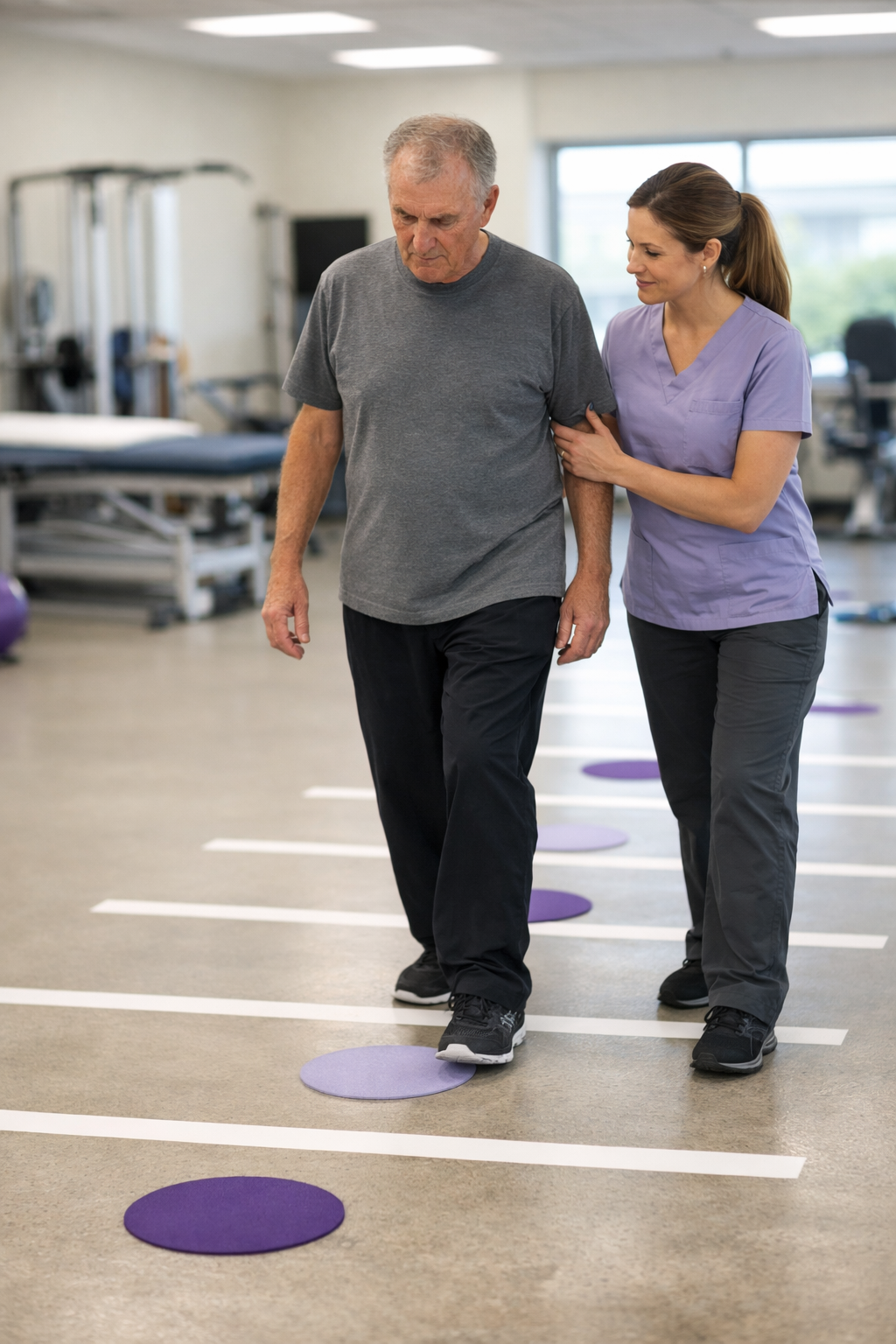
“Step to the next tape line.”
“Aim your heel past the stripe.”
“Push the floor back with every step.”
Parkinson example: walking that doesn’t get stuck in your head
In Parkinson disease, movement can become smaller, slower, and more “effortful,” and people may freeze or shuffle—especially when they start thinking about how to move.
Internal focus cue: “Pick up your feet.”
External focus cues (better starting point):
“Step to the next tape line.”
“Aim your heel past the stripe.”
“Push the floor back with every step.”
“Match your steps to the beat.”
External targets (lines, dots, cones, laser cues, metronomes) give your brain a clear destination, not a body-part checklist. The goal is bigger, cleaner movement—without piling on conscious control.
Stroke example: rebuilding reach and balance without micromanaging the arm
After stroke, people often compensate (shoulder hiking, trunk leaning) and get told a long list of “don’ts.” The problem: too many body rules can make movement stiff and hesitant.
External Focus:
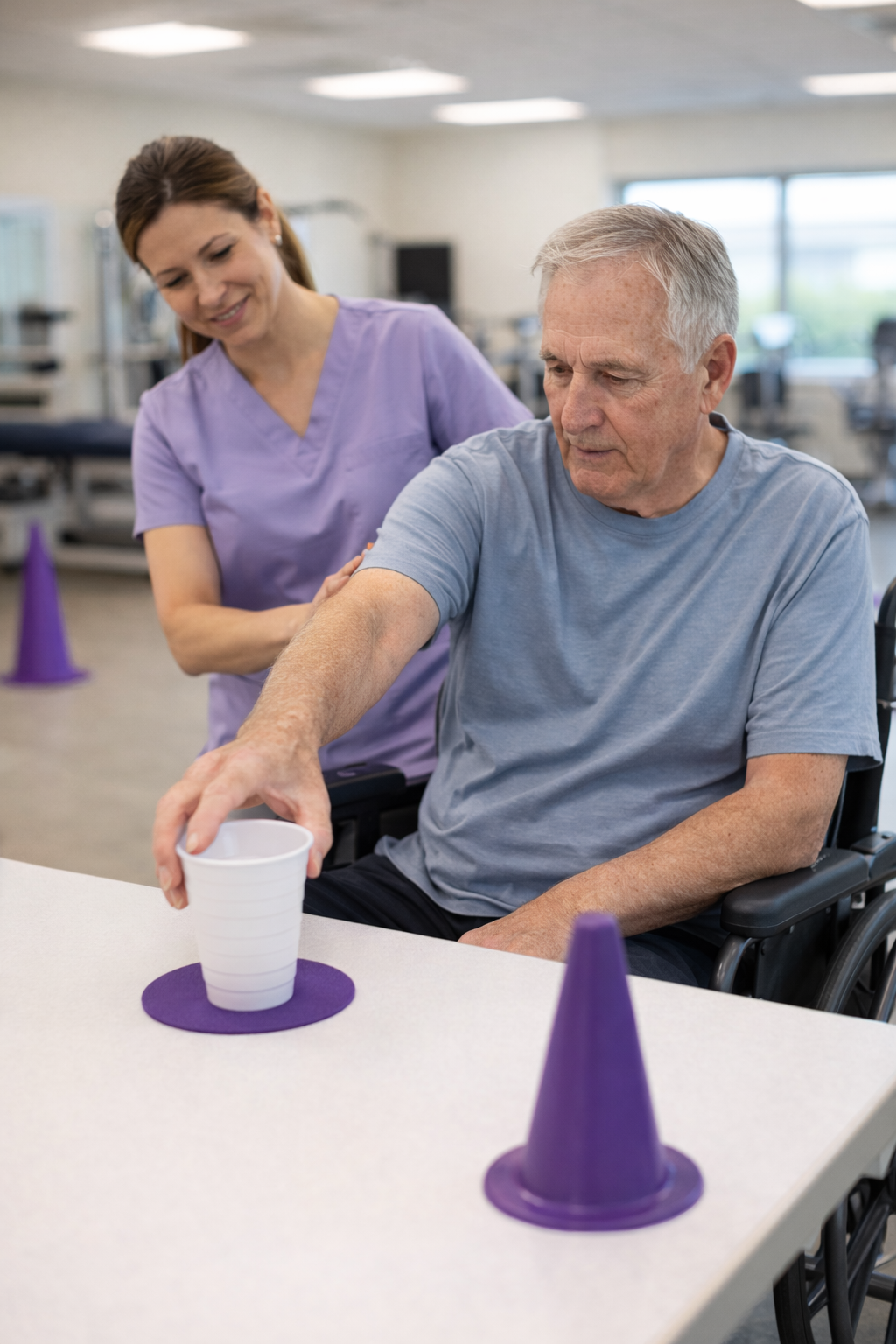
“Place the cup on the purple dot.”
Internal focus cue: “Don’t hike your shoulder—extend your elbow.”
External focus cues:
“Touch the sticker with your knuckles.”
“Slide the cloth to the far corner of the table.”
“Place the cup on the purple dot.”
“Shift your weight to light up the target on the screen.”
You’re still training the same components—shoulder control, elbow extension, trunk alignment—but you’re doing it through a task goal that encourages more natural coordination.
How we use it in clinic
We’ll still coach form when it’s necessary. But our default is: build the right environment and target so your nervous system can self-organize. OPTIMAL theory also emphasizes two other “performance boosters”: autonomy (having choices) and expectancy (feeling capable). Those stack with external focus to support learning.
(And like any theory, it’s actively debated and refined in research—so we use it as a practical guide, not a religion.)
Bottom line: If you want movement to improve, don’t just practice harder—practice smarter: aim attention outward, toward the result you want.
